
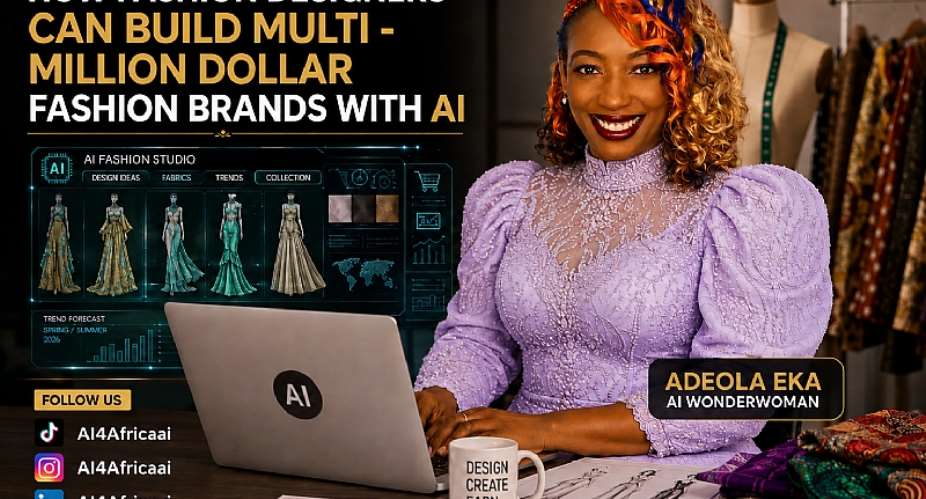
How Fashion Designers Can Build Multi-Million-Dollar Fashion Empires with AI
The fashion industry is changing rapidly. Artificial intelligence (AI) is no longer a tool reserved for global luxury brands. Today, independent designers, small fashion houses and start-ups can use AI to compete on a much larger stage.
From designing collections to attracting customers and managing inventory, AI offers practical solutions that save time, reduce costs and support business growth.
For fashion entrepreneurs in Ghana and across Africa, AI presents an opportunity to build globally competitive brands without the large budgets once required to succeed.
AI Is Transforming the Fashion Business
Fashion has always relied on creativity. Today, data has become just as important.
AI combines both. It helps designers make informed decisions while allowing them to focus on creativity and innovation.
Instead of spending weeks researching trends or creating marketing campaigns, designers can use AI tools to complete many tasks in minutes.
That efficiency allows businesses to produce more, respond faster to market changes and improve profitability.
1. Design Collections Faster
Creating a new collection often requires weeks of research, sketching and revisions.
AI-powered design platforms can generate mood boards, color palettes and garment concepts based on a designer’s preferred style.
Rather than replacing creativity, AI acts as a creative assistant.
Designers can refine AI-generated concepts and transform them into unique collections that reflect their brand identity.
The result is faster product development without sacrificing originality.
2. Predict Fashion Trends Before They Go Viral
Successful brands rarely follow trends.
They identify them early.
AI analyzes millions of online searches, social media posts and shopping patterns to identify emerging fashion preferences.
Designers can use these insights to produce collections before competitors recognize the trend.
This reduces the risk of unsold inventory while increasing customer demand.
3. Create Professional Marketing Content
Marketing remains one of the biggest challenges for many fashion businesses.
AI now makes it easier to create:
- Product descriptions
- Instagram captions
- Facebook campaigns
- TikTok content ideas
- Email newsletters
- Blog articles
- Press releases
Instead of hiring a large marketing team, designers can produce consistent, high-quality content with AI assistance.
4. Produce High-End Fashion Campaigns
Professional photoshoots can cost thousands of dollars.
AI image-generation tools now allow designers to create editorial-style campaign visuals, virtual models and lookbooks at a fraction of the cost.
Many brands combine real product photography with AI-enhanced backgrounds and creative concepts to achieve premium results.
While authentic photography remains essential for showcasing actual products, AI can reduce production costs for marketing campaigns.
5. Launch an Online Store Quickly
Every successful fashion brand needs a strong online presence.
AI-powered website builders simplify the process of creating attractive e-commerce stores.
These tools also help optimize product pages for search engines, increasing the chances of attracting customers through Google.
A well-designed online store allows fashion businesses to reach customers far beyond their local communities.
6. Improve Customer Service
Customers expect fast responses.
AI chatbots can answer common questions about:
- Sizes
- Delivery times
- Returns
- Payment options
- Product availability
This allows fashion business owners to focus on design, production and business development while maintaining responsive customer service.
7. Manage Inventory More Efficiently
Poor inventory management often leads to financial losses.
Some businesses overproduce.
Others run out of popular products.
AI analyzes historical sales and customer demand to estimate future inventory needs.
This helps designers produce the right quantities while reducing waste.
8. Personalize the Shopping Experience
Customers are more likely to buy when products match their preferences.
AI studies browsing behavior and purchase history to recommend items each customer is more likely to purchase.
This personalized approach can increase sales and strengthen customer loyalty.
9. Reach Global Markets
A designer in Accra, Kumasi or Lagos can now sell products worldwide.
AI-powered translation tools, digital advertising platforms and automated customer support make international expansion more accessible.
Fashion entrepreneurs no longer need physical stores in multiple countries to reach global customers.
10. Make Better Business Decisions
Many small businesses rely on instinct.
Successful brands combine instinct with data.
AI dashboards provide insights into:
- Best-selling products
- Customer demographics
- Revenue trends
- Marketing performance
- Seasonal demand
These insights help business owners make smarter decisions.
AI Tools Fashion Designers Can Explore
Several AI platforms can support different parts of a fashion business.
Designers may consider tools such as ChatGPT for content creation and brainstorming, Adobe Firefly for creative image generation, Canva AI for marketing materials, Shopify Magic for e-commerce assistance, and Google Gemini or Microsoft Copilot for productivity and business planning.
Before adopting any AI solution, designers should review pricing, licensing terms and data privacy policies to ensure the tools meet their business needs.
The Human Touch Still Matters
AI can improve efficiency, but it cannot replace originality, craftsmanship and personal storytelling.
Customers often choose fashion brands because of their unique identity and the values they represent.
Designers should use AI to support their creativity rather than allow it to define their brand.
The strongest fashion businesses combine technology with authentic design and quality craftsmanship.
Opportunities for Ghana and Africa
Africa’s fashion industry continues to gain international recognition.
Designers are showcasing local fabrics, cultural influences and innovative designs on global runways.
AI can help accelerate that growth by lowering operating costs and improving access to international markets.
With the right strategy, African fashion brands can compete alongside established global labels while celebrating their unique heritage.
Looking Ahead
Artificial intelligence is reshaping fashion, but success will still depend on vision, discipline and execution.
Designers who embrace technology while preserving originality will be better positioned to grow sustainable businesses.
AI is not a shortcut to success. It is a powerful tool that can help fashion entrepreneurs work smarter, respond faster to changing markets and expand into new opportunities.
For designers willing to learn and adapt, AI could become one of the most valuable investments they make as they build the next generation of successful fashion brands.